We've traced batch inconsistency back to spice measurements enough times to say that with certainty. A small-batch recipe gets multiplied to production volume. The ratios look correct. The process is identical. But something is off — and it takes several runs to find it. The culprit is almost always a volume-based spice measurement that worked at tablespoon scale and quietly compounded into a significant error at 50-pound scale.
Here's what we've observed: when you multiply an imprecise measurement by a production factor of 20, 50, or 100, you don't just scale the recipe. You scale the error.
What this guide covers:
Why volume-based spice measurements fail at production scale — and exactly where the error enters the formula
How to convert small-recipe volumes to gram weights before applying any scaling factor
Yield data for the spices where density variation creates the greatest scaling risk
How to build weight-based spice specs into standardized production recipes that hold across supplier changes and formula adjustments
The spices in your production formula aren't interchangeable units of volume. A teaspoon of ground cloves and a teaspoon of dried dill occupy the same space and deliver a completely different amount of material. We've measured the density spread across common production spices. It's 2.5x from lightest to heaviest, which is exactly why a spice yield conversion chart becomes essential for translating volume measurements into accurate weight at production scale. At a small-batch scale that gap is manageable. At production scale it's a formula problem.
If a scaled batch isn't matching the original, the answer is almost always in the conversion step that happened — or didn't — before the math began.
TL;DR Quick Answers
Spice Yield Conversion Chart
A spice yield conversion chart translates volume measurements into actual gram weights — accounting for the density differences that make a universal conversion factor unreliable at production scale.
Why it matters at production scale specifically:
Common production spices vary by a factor of 2.5 in weight per teaspoon — lightest to heaviest
A universal conversion factor applied across that range is wrong for a significant portion of any production formula
A measurement error that disappears into a small batch gets multiplied across every unit at production volume
The chart is what converts a volume-based development recipe into a weight-based formula before any scaling factor is applied
Density categories to know:
Dense spices (ground cloves, mustard seed, black pepper): more weight per teaspoon — scaling errors run heavy
Medium spices (cumin, coriander, cinnamon, turmeric): mid-range yield — supplier variation is the primary risk
Light spices (dill seed, dried parsley, celery seed): less weight per teaspoon — scaling errors run thin
Who needs it:
Production operations scaling development recipes to commercial volume
Any facility applying a scaling factor to volume-based spice specifications
Operations managing supplier changes without re-verifying yield data between runs
Anyone troubleshooting batch inconsistency that the scaling math can't explain
Bottom line: Volume measurements tell you how much space a spice occupies. A yield conversion chart tells you how much spice you actually have. At production scale, only one of those numbers belongs in a formula.
Top Takeaways
Scaling errors originate before the math — not in it. Volume-based spice measurements multiplied by a production factor don't scale a recipe. They scale the error already in the measurement.
A 2.5x density spread makes universal conversion wrong for a significant portion of any production formula. Highest-risk spices at production scale:
Ground cloves
Mustard seed
Dill seed
Dried parsley
Material costs represent 60+ cents of every production dollar (USDA ERS). At that ratio, systematic measurement errors don't get absorbed by margin. They come directly out of it.
Supplier changes are formula variables — not procurement events. Three things that shift what a volume measurement delivers:
Different grind specification
New crop year
Different supplier origin
Successful scaling operations share one structural decision — not better equipment or tighter process controls:
Convert spice specs to gram weights once
Build those weights into the standardized production formula
Express grams as the primary unit — volume as secondary field reference only
That single decision separates formulas that reproduce reliably from formulas that require constant troubleshooting.
Why Volume Measurements Break Down at Production Scale
Small-batch recipes are written for cooks who can taste and adjust. Production formulas are written for processes that don't stop to recalibrate mid-run.
That distinction matters for every ingredient — but it matters most for spices. At tablespoon scale, a measurement error of 10 or 15 percent gets absorbed by the dish. At production scale, that same percentage error gets multiplied across every unit in the batch. By the time it surfaces, you've already committed the run.
What we've measured across common production spices:
Density ranges from 0.35 tsp/g for dense spices to 0.90 tsp/g for light dried herbs
That's a 2.5x spread from heaviest to lightest
A universal conversion factor applied across that range is wrong for roughly half the spices in a typical production formula
The error isn't random — it's directional and predictable once you know which spices carry the highest density variation
Volume measurements don't fail because cooks measure carelessly. They fail because volume is the wrong unit for a material with variable density. When a recipe template is built around weight-based measurements instead of volume, it accounts for those density differences and keeps calculations consistent from the start. Scaling doesn't fix that problem. It amplifies it.
The Conversion Step Most Production Formulas Skip
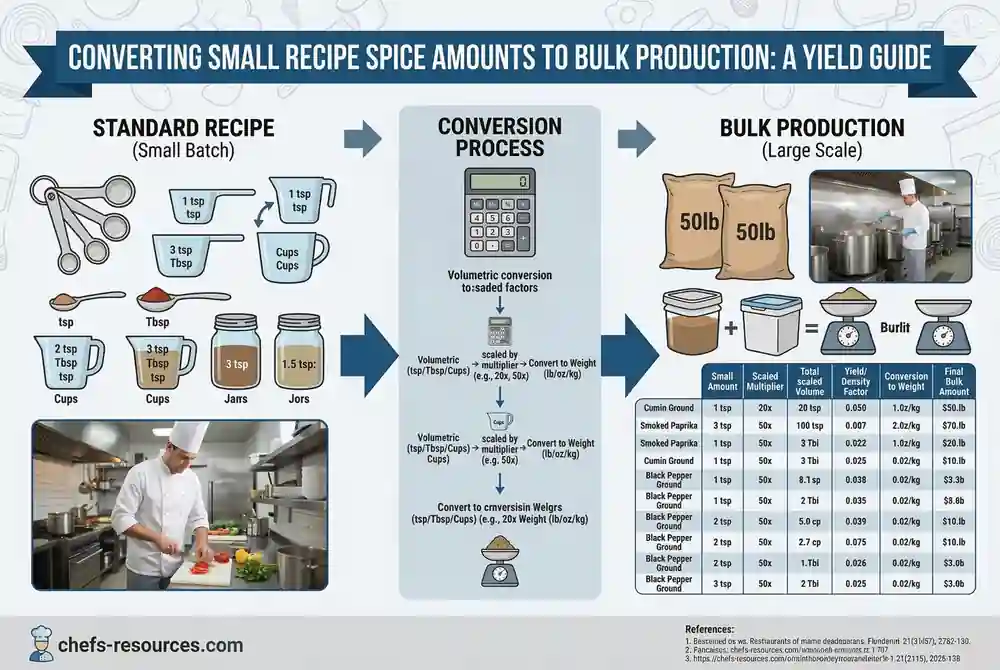
Before any scaling factor gets applied, every spice in the formula needs to be expressed in weight — not volume. This is the step we see skipped most often, and it's the step that determines whether the scaled formula matches the original.
The conversion process:
Identify every spice in the original recipe expressed as a volume measurement
Pull density-specific yield data for each spice — not a universal factor
Convert each volume measurement to grams using the spice-specific yield
Express the converted gram weights as the formula baseline
Apply the production scaling factor to gram weights only — never to original volumes
What this accomplishes: the scaling math now operates on a fixed unit. A gram of ground cloves at 50-pound scale is the same as a gram of ground cloves at small-batch scale. A teaspoon of ground cloves is not the same thing twice in a row, and it's certainly not the same thing multiplied by 100.
Spices With the Highest Density Variation at Production Scale
Not every spice carries equal scaling risk. The spices that create the most significant production errors are the ones with the highest density variation — either because they're at the extreme ends of the density range, or because their density shifts significantly between whole and ground form.
High-risk spices for production scaling:
Cloves (ground): Dense, high weight per teaspoon — scaling errors run heavy, over-seasoning the formula
Mustard seed (whole vs. ground): Significant yield difference between forms — substitution without conversion data changes the formula measurably
Dill seed: Light and variable — scaling errors run thin, under-delivering flavor at volume
Coriander (whole vs. ground): Yield difference between whole and ground large enough to shift a spice blend profile across a full production run
Cayenne: Fine grind, high density variation by supplier — same volume from two different suppliers can deliver meaningfully different heat levels at scale
Medium-risk spices where supplier and grind differences accumulate:
Paprika
Cumin
Cinnamon
Turmeric
Ginger (ground)
How Supplier and Grind Differences Compound at Scale
At small-batch scale, switching spice suppliers mid-season is a minor inconvenience. At production scale, it's a formula variable that needs to be managed.
What changes when a supplier or grind specification changes:
Particle size shifts — finer grinds pack more densely, delivering more weight per teaspoon
Moisture content varies — drier spices are lighter per volume than spices with higher moisture retention
Origin differences affect density — the same spice from two growing regions can measure differently by weight per common volume
What we recommend when a supplier changes mid-production run:
Weigh the new supply against the documented gram weight from the previous supplier
Identify the delta — even a 5% difference in weight per teaspoon compounds across a large batch
Adjust the volume specification in the formula before the first production run with the new supply
Document the new supplier's yield data alongside the previous entry
The formula should describe what goes into the product by weight. The volume measurement is a field reference for the production line — not the source of truth for the formula itself.
Building a Weight-Based Spice Specification Into a Production Formula
The goal is to convert once and build the result into the formula permanently. Every subsequent production run operates from weight-based specs. Volume measurements become a secondary reference, not the primary one.
A working system for production spice specs:
Document gram weight per teaspoon and tablespoon for every spice in the formula, from your current supply
Note supplier, origin, and grind specification alongside each weight entry
Express the production formula in grams as the primary unit, with volume equivalents in a secondary column for line reference
Assign a tolerance range to high-variation spices — the acceptable gram weight window per batch unit
Set a re-verification trigger for any supplier change, new crop year, or formula adjustment
What this system eliminates:
Batch-to-batch inconsistency from different cooks measuring the same volume differently
Formula drift from supplier changes that go undetected until a quality complaint surfaces
The compounding effect of small measurement errors across high-volume production runs
Scaling Spice Blends Versus Individual Spices
Scaling an individual spice and scaling a spice blend are not the same problem. A blend introduces a second layer of yield variation — the interaction between multiple spices with different densities measured together as a combined volume.
What changes when scaling a blend:
Each component spice carries its own density — the blend's overall density depends on the ratio of components
A volume measurement of the finished blend is not a reliable production unit across batches
Individual components need to be weighted separately, then combined — not measured as a pre-mixed volume
The most reliable approach to production-scale spice blends:
Deconstruct the blend into individual components
Convert each component to gram weight using spice-specific yield data
Build the blend formula in grams per component
Scale gram weights to production volume
Mix to weight, not to volume, at every production run
We've seen blended spice formulas drift significantly when the blend was scaled as a combined volume. The error wasn't in any single spice. It was in treating a variable-density mixture as a fixed unit and multiplying accordingly. At production scale, that assumption doesn't hold.
"The scaling errors we get called in to troubleshoot almost never live where operators expect them. Someone multiplied a volume-based spice measurement by a production factor of 50 without first converting to weight — and a 15 percent error that disappeared into a small batch is now running through every unit in a 200-pound production run. We've measured the density spread across common production spices. It's 2.5x from lightest to heaviest. At a tablespoon scale a cook's palate absorbs that gap. At production scale it's a formula problem. In a kitchen brigade system, where responsibilities and production tasks are distributed across multiple roles, accurate measurements ensure that every station follows the same formula without variation. The operators who scale successfully aren't doing more sophisticated math. They're working from a better unit of measure before the math begins."
Essential Resources
Chefs Resources Dry Spice Yield Chart — The Conversion Reference We Built Because Universal Factors Fail at Production Scale
We built this chart because a single conversion factor applied across a full production spice shelf is wrong for roughly half the spices on it. It organizes 40+ spices by density category so the gram weight conversion happens before the scaling math — not after the batch comes back inconsistent. URL: https://www.chefs-resources.com/culinary-conversions-calculators-and-capacities/dry-spice-yields/
USDA FoodData Central — The Federal Database We Use to Cross-Check Yield Data Before It Goes Into a Formula
When a spice isn't on our chart or a figure needs verification, this is where we go. Hundreds of spices. Verified gram weights per common measure. The most authoritative secondary source available for validating production specs before they're locked in. URL: https://fdc.nal.usda.gov/
Oklahoma State University Extension — A Research-Backed Framework for the Volume-to-Weight Conversion Problem
University-sourced guidance that addresses exactly what goes wrong when kitchen recipes get multiplied to production volume without converting units first. Covers the specific challenges spices present at scale — including why they're more problematic than most other ingredients in a production formula. URL: https://extension.okstate.edu/fact-sheets/scaling-up-your-food-process.html
Michigan State University Extension — The Procedural Reference for Converting Volume Recipes to Commercial Weight Formulas
Step-by-step protocol for moving from a volume-based small-batch recipe to a commercial weight-based formula. Includes specific guidance for light ingredients like spices that don't register accurately on standard scales at small measure — a problem we see trip up production teams regularly. URL: https://www.canr.msu.edu/news/converting-a-kitchen-recipe-to-a-commercial-formula
FoodCrumbles — Why Percentage-Based Formulation Is What Production-Scale Operations Use Instead of Volume
This is the next step after gram-weight conversion — expressing every component as a percentage of total formula weight. It's how large-scale manufacturers eliminate volume-based scaling errors entirely. If you're moving from development to production volume, this is the methodology worth understanding. URL: https://foodcrumbles.com/how-to-scale-up-recipe-manufacturing/
Shamrock Foods Dry Spice Conversions — A Production-Grade Cross-Reference Built for Accuracy at Scale
A foodservice-grade weight-to-volume reference built for production environments. We use it as a secondary cross-check when verifying spice specs across supplier changes or formula adjustments — not as a primary source, but as a useful data point when something doesn't look right. URL: https://www.shamrockfoodservice.com/wp-content/uploads/2018/05/DrySpiceConversions.pdf
Allied Kenco Spice Conversions Chart — An Ounce-to-Volume Reference Worth Having When Working From Weight-Based Production Formulas
A practical ounce-to-volume reference for commonly used production spices. Keep it alongside the yield chart when working from ounce-based formulas and confirming volume equivalents during scaling — not as a replacement for density-specific data, but as a fast field reference. URL: https://www.alliedkenco.com/pdf/Spice%20Conversions.pdf
These essential resources support accurate spice yield data, verified weight references, and production-scale conversion methods so kitchens can keep formulas consistent as batches grow, an approach that strengthens kitchen management by ensuring recipes, measurements, and scaling decisions remain precise across the entire production process.
Supporting Statistics
Stat 1 — Material Costs Constitute 60% or More of Gross Output in Food Manufacturing
The number that reframed how we think about spice measurement — not just as a flavor issue, but as a production economics issue:
Material costs make up 60 percent or more of gross output value across the food manufacturing sector. Source: USDA Economic Research Service.
When ingredient costs represent 60 cents of every production dollar, a systematic measurement error running through every unit isn't a quality footnote — it's a direct hit to the number that matters most.
What we've observed when volume-based spice specs go unexamined at production scale:
A 10–15% measurement error that disappears into a small batch compounds across every production unit at volume
Systematic overuse or underuse runs directionally through the entire run — it doesn't average out
Operations troubleshoot inconsistent product for weeks without identifying the actual cause
The cause, almost every time:
Volume measurements that were never converted to gram weights
A scaling factor applied to a number that was already off-spec
A formula that looked correct — and was wrong from the first step
Source: USDA Economic Research Service — Food Manufacturing Productivity and Its Economic Implications URL: https://ers.usda.gov/sites/default/files/_laserfiche/publications/47433/54027_tb1905c.pdf
Stat 2 — Human Error Is the Leading Cause of Food Waste at the Manufacturing Level, Accounting for More Than 10% of Manufacturing Waste
The statistic we come back to most often when making the case for weight-based production specs:
Human error — absent standard operating procedures and inadequate training — is the primary cause of food waste at the manufacturing level, accounting for more than 10% of manufacturing-level waste.
What this looks like in production environments — and we've seen all of it:
Three people on three shifts measuring one tablespoon of ground cloves three different ways — all certain they're following the recipe
A supplier change processed without re-verifying yield data before the next run
A scaling factor applied to a volume measurement that was already off-spec before the math began
What this pattern produces:
Batch inconsistency attributed to process variability — when it's a measurement problem
Off-spec waste that never gets traced back to the formula conversion step
Repeated production runs attempting to replicate a result the original measurement system couldn't produce consistently
The 10% figure is avoidable waste. Not spoilage. Not distribution loss. Production decisions made without adequate measurement systems. Converting spice specs to gram weights — once — is one of the most direct fixes available.
Source: RTS — Food Waste in America (citing EPA/USDA food waste research) URL: https://www.rts.com/resources/guides/food-waste-america/
Supporting Reference: USDA — Food Waste FAQs URL: https://www.usda.gov/about-food/food-safety/food-loss-and-waste/food-waste-faqs
Stat 3 — 31% of the U.S. Food Supply at Retail and Consumer Levels Goes Uneaten — 133 Billion Pounds Annually
The scale of the problem, from USDA Economic Research Service:
31% of food available for consumption at retail and consumer levels goes uneaten
133 billion pounds annually
USDA and EPA national goal: 50% reduction in food loss and waste by 2030
The connection between spice measurement accuracy and that 133-billion-pound figure is more direct than it looks:
Flavor inconsistency from measurement variation drives product rejection
Off-spec batches from scaling errors generate production waste before distribution
New product development — when scaling errors are most likely — creates disproportionate waste during production coordination
The reduction path that gets the least attention is inside the formula itself:
Measurement errors that produce off-spec batches contribute to the waste stream before any external factor
Weight-based specs eliminate a category of waste that's entirely within a producer's control
Documented gram weights, built into standardized recipes once, remove the human variable that drives manufacturing waste
We're not suggesting spice yield conversion solves a 133-billion-pound problem. The part of that problem that lives inside a production formula is completely preventable — at zero cost beyond converting once.
Source: USDA Economic Research Service — Food Loss: Questions About the Amount and Causes Still Remain URL: https://www.ers.usda.gov/amber-waves/2014/june/food-loss-questions-about-the-amount-and-causes-still-remain
Supporting Reference: USDA — Food Loss and Waste 2030 Goal URL: https://www.usda.gov/about-food/food-safety/food-loss-and-waste
These statistics show that when ingredient measurements are inaccurate, the impact spreads across production costs, waste, and batch consistency, which is why precise weight-based formulas are essential for maintaining quality and efficiency when producing farm-fresh food at scale.
Final Thought & Opinion
We've been called in to troubleshoot batch inconsistency in production operations more times than we can count. The protein is right. The process is right. The scaling math checks out. The product still doesn't match the original.
It's almost always the same problem. Someone scaled a volume-based spice measurement by a production factor of 20, 50, or 100 without first converting to weight. Invisible at small-batch scale. Running through every unit at production scale.
What two decades of watching this repeat has taught us:
The scaling step isn't where production spice errors originate — the conversion step that didn't happen before it is
Volume measurements don't fail because people measure carelessly — they fail because volume is the wrong unit for a material with variable density
A 2.5x density spread means a universal conversion factor is wrong for a significant portion of any production formula
Supplier changes, grind differences, and moisture variation shift what a volume measurement delivers — and none of those variables show up until a batch comes back inconsistent
Our opinion, stated plainly:
Weight-based spice specs aren't a best practice. They're a baseline. Any production formula still written in volume-only units for spices is operating with a measurement system that cannot produce consistent results — not because of anything the production team is doing wrong, but because the unit of measure doesn't correspond to a fixed quantity of material.
What the operations that scale successfully have in common — and we've observed this consistently across facilities of every size:
It isn't more sophisticated equipment. It isn't tighter process controls. It's that someone, at some point in their development history, converted spice specs to gram weights and built those weights into the standardized formula before the scaling factor was ever applied. That one step — done once — separates formulas that reproduce reliably from formulas that require constant troubleshooting.
Three changes that would improve outcomes for most production operations immediately:
Convert every spice in the formula to gram weights using density-specific yield data — not a universal factor
Treat supplier changes like formula adjustments — re-verify yield data before the first production run with new supply
Express the production formula in grams as the primary unit — volume equivalents are a field reference, not the source of truth
The numbers that frame why this matters:
Material costs represent 60 cents or more of every production dollar in food manufacturing (USDA ERS)
Human error is the leading cause of manufacturing-level food waste — more than 10% of manufacturing waste
Both figures trace back, more often than the industry acknowledges, to measurement systems that were never built for the scale they're being asked to serve
The fix isn't expensive. It isn't complicated. It requires density-specific yield data, a 0.1g scale, and the discipline to convert once and document the result permanently.
FAQ on Spice Yield Conversion Chart for Bulk Production Scaling
Q: What is a spice yield conversion chart and why does it matter for production scaling?
A: A spice yield conversion chart maps volume measurements to actual gram weights — accounting for density differences a universal conversion factor ignores. Why it matters at production scale:
A 10–15% measurement error at small-batch scale gets absorbed
Multiplied by a production factor of 50 or 100, it runs through every unit in the batch
The chart converts a volume-based development recipe into a weight-based production formula before any scaling factor is applied
Without it, you're not scaling a recipe. You're scaling whatever error was already in the measurement. We've watched this play out across facilities of every size. It's always the same problem.
Q: Why do volume-based spice measurements fail at production scale when they worked fine in small-batch development?
A: Because the error was always there — production scale just makes it visible. The density spread across common production spices runs 2.5x from lightest to heaviest. Three conditions that amplify the failure at scale:
Multiple operators measuring the same volume specification differently across shifts
Supplier changes processed without re-verifying yield data before the next run
Spice blends scaled as combined volumes instead of individual component gram weights
A cook's palate absorbs a 2.5x density gap at a tablespoon scale. At a production factor of 100, it's a formula problem.
Q: How do I convert a small-batch recipe's spice measurements to a weight-based production formula?
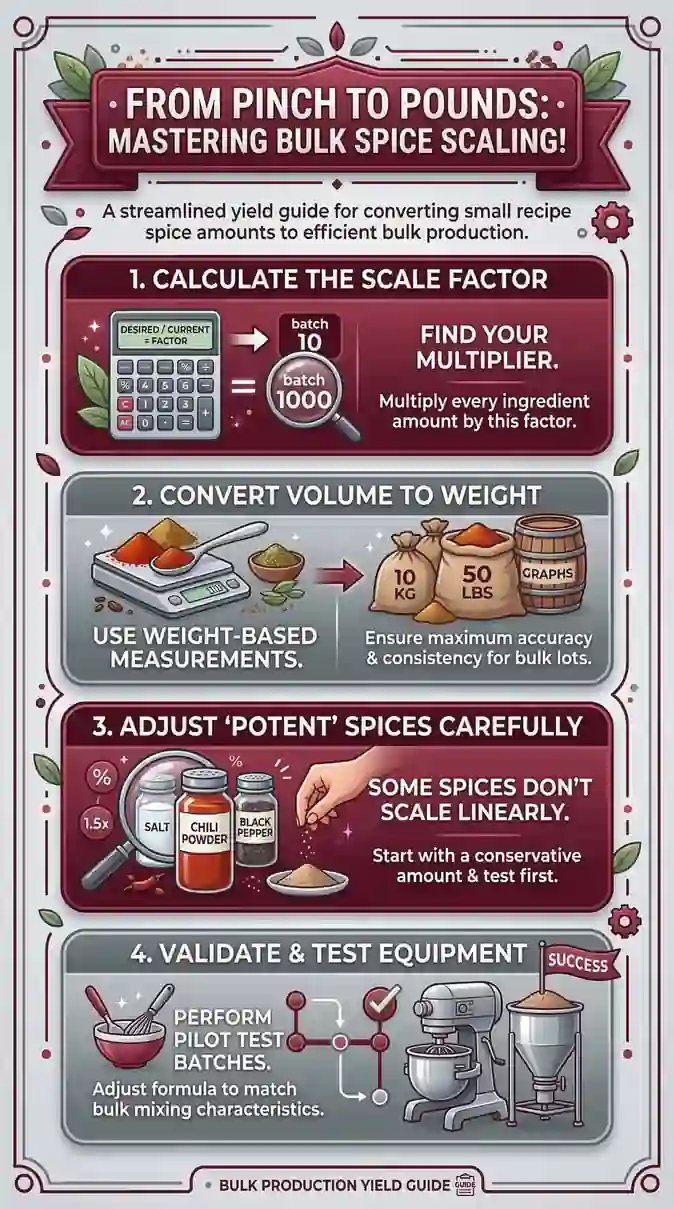
A: Convert before you scale — not after. The sequence that eliminates the error at the source:
Identify every spice expressed as a volume measurement in the original recipe
Pull density-specific yield data for each spice — not a universal factor
Convert each volume to grams using the spice-specific yield
Express those gram weights as the formula baseline
Apply the production scaling factor to gram weights only — never to original volumes
Document supplier, grind specification, and date measured alongside each entry
A gram of ground cloves at 50-pound production scale is identical to a gram of ground cloves at small-batch scale. A teaspoon of ground cloves is not the same thing twice in a row — and certainly not the same thing multiplied by 100.
Q: Which spices create the most significant errors when scaling from small-batch to production volume?
A: The spices at the extreme ends of the density range — or where density shifts substantially between whole and ground form. From our own measurements, these generate the most production callbacks:
Highest-risk for production scaling errors:
Ground cloves — dense, heavy per teaspoon — errors run heavy, over-seasoning the formula
Mustard seed — significant yield gap between whole and ground forms
Dill seed — light and variable — errors run thin, under-delivering flavor at volume
Coriander — whole-to-ground yield difference large enough to shift a full blend profile
Cayenne — high supplier-to-supplier density variation — same volume, different heat at scale
Medium-risk where supplier and grind differences accumulate quietly:
Paprika
Cumin
Cinnamon
Turmeric
Ground ginger
Q: How do supplier changes affect spice yield at production scale, and how should they be managed?
A: A supplier change is a formula variable — not a procurement event. That reframe is what changes how production teams handle it. What shifts when a supplier or grind specification changes:
Particle size — finer grinds pack more densely, delivering more weight per teaspoon
Moisture content — drier spices are lighter per volume
Origin differences — the same spice from two growing regions can measure differently by weight
The protocol we recommend for every supplier change:
Weigh new supply against documented gram weight from the previous supplier
Identify the delta — even 5% compounds significantly across a large batch
Adjust the volume specification before the first production run with new supply
Document the new supplier's yield data alongside the previous entry
A supplier change that goes unverified against documented gram weights is a formula adjustment that nobody approved. We've traced weeks of batch inconsistency back to exactly that scenario. It needs to be treated accordingly.